The Journal
How Mature Tree Canopy Shapes Values in Providence Country Club
The mature hardwood canopy at Providence Country Club defines streetscapes, shelters microclimates, and influences site planning across South Charlotte.
Providence Guide editorial teamOctober 4, 2026
The Architectural Weight of Established Canopy
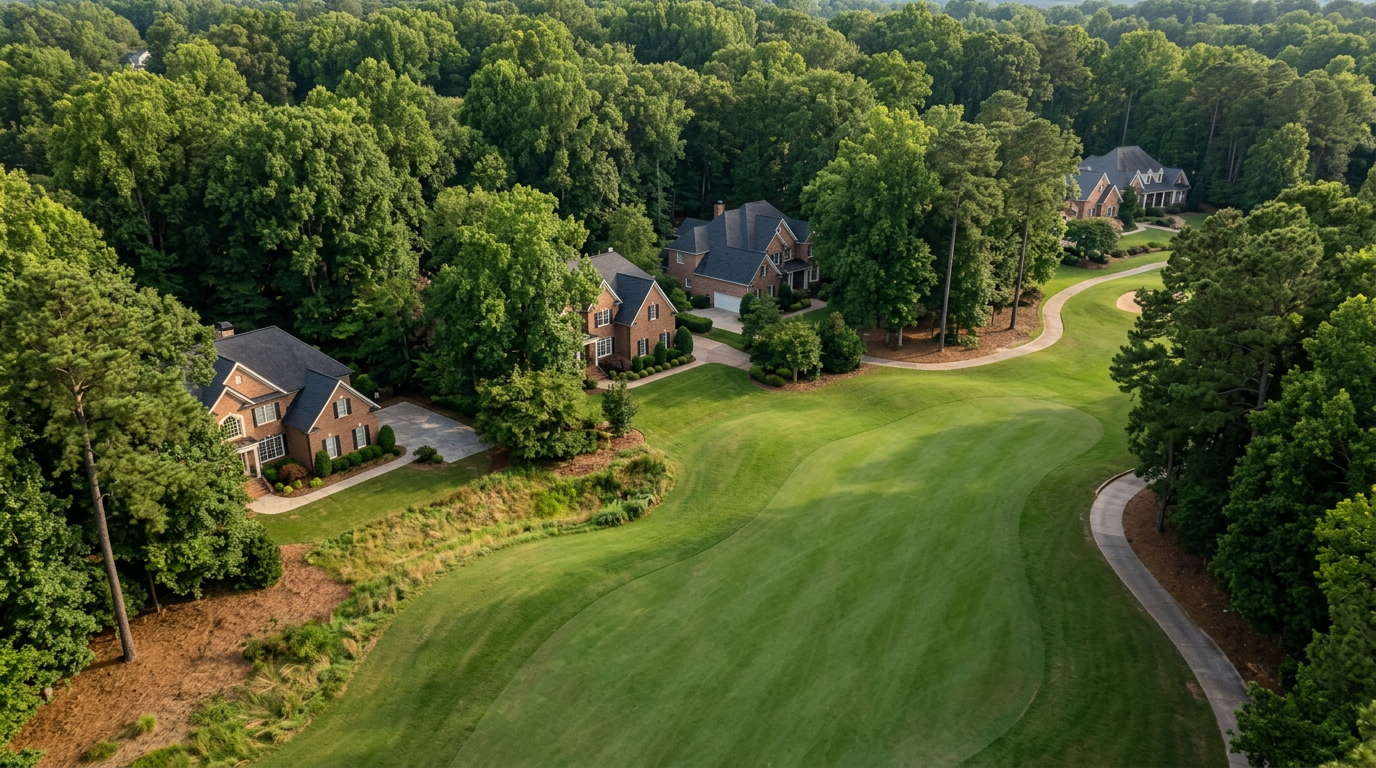
The mature tree canopy shapes property value inside Providence Country Club by providing established scale, natural privacy, and thermal moderation that newly cleared subdivisions simply cannot replicate. In a mature South Charlotte master-planned neighborhood developed across rolling Piedmont terrain, the mix of native willow oaks, white oaks, sweetgums, and towering loblolly pines anchors custom brick and stone residences. Buyers evaluate tree cover not merely as decorative greenery, but as an irreplaceable architectural baseline that immediately confers pedigree and spatial buffer. Properties featuring well-maintained canopy often attract sustained interest precisely because reproducing fifty-year-old hardwoods requires decades of patience. Consequently, tree density and composition play a decisive role in comparative valuations across every residential street.
Streetscapes throughout Providence rely heavily on continuous green borders to soften rooflines and reduce visual density. When residences sit along curving avenues, broad canopies visually anchor the architecture into the topography, creating an understated street appeal that distinguishes established communities from modern high-density builds. This biological framework also delivers measurable physical benefits, tempering the intense summer heat typical of the Carolina Piedmont. Pavement and roof surfaces sheltered under dappled shade experience significantly lower radiant heat, which improves the livability of front terraces and exterior walkways. Prospective homeowners touring the neighborhood routinely perceive this environmental equilibrium as a marker of lasting quality and quiet residential prestige.
Microclimates and Outdoor Living Design
In South Charlotte, high-end residential living extends substantially into the outdoors, where mature canopies directly dictate terrace utility and seasonal comfort. Shaded rear elevations allow homeowners to build expansive stone patios, outdoor kitchens, and covered loggias that remain comfortable through the warmest Carolina summer afternoons. Conversely, clear-cut parcels require extensive artificial shade structures, pergolas, or oversized automated screens to mitigate southern exposure. The existing canopy filters prevailing breezes while tempering direct ultraviolet radiation, creating localized microclimates that prolong the daily usability of outdoor living spaces. Landscape designers frequently use the dappled lighting created by mature hardwoods to cultivate delicate ground covers and ornamental plantings that would wither under unrelenting sun.
Integrating swimming pools, plunge spas, and hardscapes around mature trees presents a delicate balance between outdoor leisure and environmental stewardship. Homeowners must weigh the cooling shelter of high branches against the seasonal maintenance of organic debris, falling leaves, and pollen cycles. Smart home automation systems and robotic filtration assist in managing seasonal leaf drops, yet site designers prioritize placement that catches midday sun on water surfaces while retaining natural shade over adjacent lounge pavilions. Uplighting integrated into ancient oak trunks and understory dogwoods transforms evening gardens into layered visual landscapes, generating the dramatic nocturnal presence that buyers expect from luxury properties in the Carolina Piedmont.
Dan Maples Course Routing and Green Buffers
When golf course architect Dan Maples shaped the championship layout at Providence Country Club, he preserved extensive stands of indigenous Carolina hardwoods and tall loblolly pines to frame the fairway corridors. These trees do not simply define playing corridors and directional challenges for golfers; they establish a vital living buffer between active fairways and private home boundaries. Parcels backing onto the course benefit enormously from deep tree screens that absorb acoustic disruptions from grounds equipment and protect property boundaries from errant shots. The visual rhythm of sunlight breaking through pine branches across manicured turf constitutes a core luxury asset, elevating interior views from great rooms, sun porches, and primary suites.
Over time, the relationship between fairway maintenance and private lot foliage requires measured adjustments to protect both the course and private lawns. Deep canopy can shade putting greens or tee boxes excessively, while dense root systems occasionally compete with specialized turfgrass varieties for subterranean moisture. The golf maintenance team continually evaluates course health, while adjacent homeowners coordinate boundaries to ensure mutual sunlight and sightlines. Buyers considering golf-frontage lots should review lot survey stakes and consult club management regarding scheduled tree trimming along property boundaries, ensuring their long-term expectations align with the ongoing agronomic management of the Dan Maples routing.
Site Planning, Expansion, and Root Preservation
Renovating or expanding an existing residence in Providence requires rigorous site planning to protect the critical root zones of legacy trees. The expansive root systems of white oaks and mature maples extend well beyond their driplines, making them vulnerable to soil compaction from heavy machinery, excavation for foundations, and grade alterations. Structural engineers and custom builders operating in South Charlotte frequently employ specialized techniques, such as hydro-excavation, hand-trenching for utility feeds, and cantilevered footings, to avoid severing structural roots. Neglecting tree protection during an interior expansion, garage addition, or pool installation can initiate a slow, irreversible decline in canopy health that takes years to manifest.
Homeowners investing in significant exterior renovations increasingly enlist certified consulting arborists before finalizing architectural blueprints. These tree specialists conduct pre-construction vigor assessments, map underground root architectures, and establish non-negotiable protection fences around critical root zones. Preserving a century-old oak on a building envelope requires proactive soil aeration, deep-root fertilization, and moisture monitoring throughout construction. While these engineering safeguards add complexity and cost to custom building schedules, the alternative—removing a destabilized or dying landmark tree post-construction—incurs substantial removal costs and degrades the property’s architectural presence and intrinsic market value.
Regulatory Compliance and Architectural Standards
Navigating tree preservation inside Providence Country Club involves a two-tiered regulatory environment encompassing both municipal codes and community covenants. The City of Charlotte enforces strict tree protection provisions under the Unified Development Ordinance, which mandates canopy preservation standards and commercial or residential tree removal mitigation across Mecklenburg County. Concurrently, the Providence Country Club Homeowners Association Architectural Review Committee oversees tree clearing, property improvements, and landscape alterations to preserve the community's established aesthetic harmony. Residents cannot simply fell mature trees without prior ARC authorization and, where applicable, official municipal permitting, ensuring the neighborhood maintains its historic woodland character.
Prospective buyers planning comprehensive property transformations must verify local guidelines directly through the Providence Country Club HOA and the City of Charlotte planning department. Architectural covenants outline specific parameters regarding allowable tree removals, required replantings, and approved species lists that match indigenous flora. Attempting unpermitted tree clearing can trigger punitive fines, compulsory mitigation replantings, and friction with neighboring properties. Engaging a land surveyor and certified arborist early in the due diligence phase provides buyers with clear documentation of protected specimen trees, building setback limitations, and legal clearing parameters prior to closing.
Canopy Succession and Long-Term Equity
Sustaining property equity in mature Charlotte communities requires a proactive approach to tree succession and regular preventive maintenance. Forest canopies naturally age, face disease pressures, and suffer storm damage from seasonal subtropical weather systems passing through the Carolinas. Discerning homeowners do not view their landscape as static; they actively budget for structural crown thinning, deadwood pruning, lightning protection systems, and supplemental support cabling in mature hardwoods. By managing structural risks before severe windstorms arrive, owners safeguard both their physical residential improvements and the towering assets that define their property’s curb appeal.
Equally critical to generational value is the deliberate planting of understory succession trees, such as dogwoods, redbuds, and young replacement canopy oaks, to ensure future continuity. As older pines and poplars conclude their natural lifecycle, thoughtfully placed native species grow to fill sunlight gaps without compromising structural safety or solar access for modern home systems. When evaluated against newer developments characterized by clear-cut lots and sapling plantings, Providence Country Club retains a profound visual and ecological advantage. That enduring environmental maturity remains one of the quietest yet most resilient drivers of luxury real estate value across the South Charlotte landscape.
Begin the conversation
Continue through the guide
Golf, amenities, homes, building and design, and relocation — covered in depth.