Smart Home
Technology, quietly.
Audio, video, lighting, shades, and network — designed to disappear into the architecture of a Providence home.
Providence Guide editorial teamReviewed August 2026
The Providence smart-home standard.
A Providence home at scale is not a candidate for consumer-grade smart home hardware. Coverage, device count, family reliability, and the aesthetic discipline of the interior all demand a professionally engineered system — structured wiring in every room, enterprise-grade networking, professionally programmed lighting and shade control, whole-home audio designed as architecture, and a home theater treated as a room rather than an afterthought.
What matters, in order.
- Structured wiring — the foundation of everything else
- Whole-home Wi-Fi engineered for the scale of a Providence home
- Lighting control — dimmable, scene-based, tuned to time of day
- Motorized shades on the elevations that face the sun
- Distributed audio — inside, out, and on the outdoor living pavilion
- Home theater — a dedicated room, not a compromise
- Security and camera systems with discreet, high-quality hardware
Networking.
The single most important system in a Providence home is the network. A professionally engineered network runs on wired backbones to every access point, uses enterprise Wi-Fi hardware with roaming handoff, isolates guest and IoT traffic, and terminates in a dedicated equipment closet with conditioned power. Every other system — lighting, shades, audio, video, security — depends on it. Get it right first.
Lighting control.
Lighting control is where the family will feel the system every day. A well- programmed home moves quietly through daily scenes — a soft wake sequence in the primary suite at sunrise, a bright, cool morning in the kitchen, a warm evening across the main level, a low path-lit sequence overnight. Keypads live at every entry to a room, in finishes matched to the door hardware, engraved with human labels rather than "Zone 3."
Audio and video.
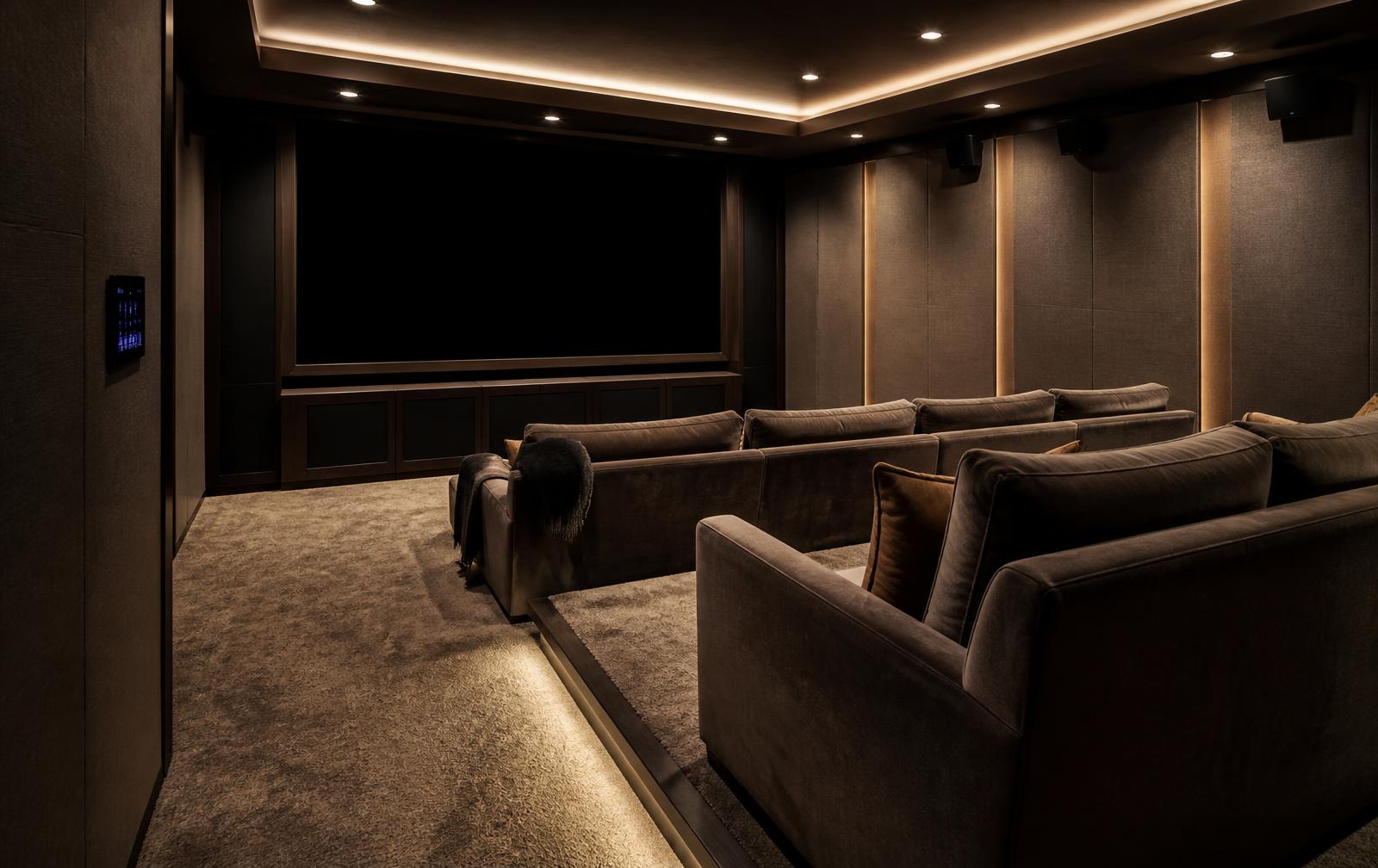
Distributed audio at Providence is best delivered through invisible speakers in the ceilings of the main living rooms, primary suite, and outdoor pavilion, driven by a rack in the equipment closet. Video is handled per room, with a media room or dedicated theater delivering the calibrated cinematic experience — laser projector, acoustically transparent screen, in-wall speakers, and a room built to specification with treated walls and dedicated HVAC returns.
Security.
Security should read as architecture, not as hardware. Cameras are chosen for resolution and finish; keypads are minimal; access control lives in the phone rather than on a wall. Providence homes typically layer a monitored alarm, an integrated camera system, doorbell and gate integration, and a discreet water leak and environmental sensor package tied to the same platform.
Design for invisibility.
The technology that ages best is the technology you don't see. Invisible speakers plaster-mounted in ceilings. Shade pockets integrated into millwork. Keypads in the same finishes as the door hardware. Networking equipment in a dedicated closet, not a garage shelf.
When should we design smart-home systems?+
Before drywall. Structured wiring, speaker placements, shade pockets, and networking closets are always cheaper — and better — pre-drywall than as a retrofit.
Do we need a dedicated network?+
For a Providence-scale home, yes. Consumer routers are not designed for the coverage, device count, and reliability a modern luxury home demands.
Can existing homes be retrofit?+
Yes. Wireless-first retrofits of lighting, shades, audio, and security are routine at Providence, though anything requiring speaker or shade pockets is best handled during a renovation touching drywall.
What about future-proofing?+
The most durable choice is a professionally engineered platform (Lutron, Crestron, Savant, or comparable) tied to a dedicated equipment closet. Individual components change; the platform and wiring remain useful for a decade or more.